Zoo Tests: a sneak peek

2017_11_06_0585web.jpg

The Coalition for Sustainable Rail, in conjunction with staff from the Natural Resources Research Institute, completed a third round of torrefied biomass fuel tests with the steam locomotives at the Milwaukee County Zoo this past Monday.  CSR will be providing more details about the findings of that research next week but, in short, it was a success!

Until then, check out the following video of Zoo train 4-6-2 No. 1924 hauling our test train. The locomotive is burning torrefied biomass fuel.

The deep "humming" noise is the locomotive "drumming." Similar to pulse jet engines, the fuel is generating so much combustable matter that the firebox is consuming more air than it can bring in at one time. As air comes through the firebed, it flash ignites, causing a small "boom." Multiply this by hundreds of bursts of air coming through the firebed at once, you get drumming. This is alleviated through better ash pan design, installing overfire tubes (like most late-model steam engines), or cracking the door a bit. Notice that the noise stops when the engineer opens the door to shovel each scoop of fuel into the firebox.

New White Paper - Preserving Solid Fuel Firing in a Post-Coal World

This white paper addresses how economic and environmental concerns are shifting global energy markets away from coal towards natural gas and other technologies, making preservation of the skills associated with solid fuel firing increasingly difficult for heritage operators. The Coalition for Sustainable Rail (CSR), in association with the Natural Resources Research Institute at the University of Minnesota - Duluth (NRRI), is working to stay ahead of this eventuality by developing a direct coal replacement employing sustainable biomass.

Preliminary results are detailed in the paper, outlining steps being taken by CSR to perform instrumented testing and refinement of this material to-date. The project is specifically designed to reduce risk associated with development of the fuel by first conducting tests in quarter scale locomotives and then systematically moving toward larger, and larger equipment. 


UPDATE: A newer version of this paper was re-uploaded in November 2017 that includes minor corrections to the text and content. 

CSR and NRRI Forge Ahead with Biofuel Research, Matching Grant Announced

The Coalition for Sustainable Rail and its research collaborators at the Natural Resources Research Institute are forging ahead with their biofuel initiatives, including pursuit of a wood-based substitute for use in coal-fired steam locomotives. Following a retooling of its large torrefaction reactor, NRRI recently hosted an event announcing the commissioning of the reactor.

NRRI initially began commissioning the reactor in Fall 2016, providing CSR some of the very first torrefied biomass made in the machine. Following those initial trials, the torrefaction reactor was taken out of service for modification and additional testing. One year later, the reactor and a new densification machine are again ready to generate fuels for testing.

The densified fuel made for CSR that was used in the second Zoo trials last fall were quite friable. NRRI has since devised a more advanced way to densify the material.

The densified fuel made for CSR that was used in the second Zoo trials last fall were quite friable. NRRI has since devised a more advanced way to densify the material.

The new densification unit creates very uniform, half-pill-shaped pellets that burn very much like coal. When burning, this fuel reacts much the same way as coal.

The new densification unit creates very uniform, half-pill-shaped pellets that burn very much like coal. When burning, this fuel reacts much the same way as coal.

A key portion of the retooling has been the installation of a more advanced densification unit that is able to create pellets with a uniform, and highly compressed profile. This will allow the fuel to burn more like coal and minimize spark emissions, especially when used in a railroad environment.

To test this theory, CSR is heading back to the Milwaukee County Zoo late this Fall to undertake another round of fuel experiments. This testing will serve to verify the viability of this new fuel in anticipation of standard gauge tests at the Everett Railroad in the New Year.

In support trials in Milwaukee and at the Everett Railroad, an anonymous rail industry sponsor has offered a matching grant to CSR. They have offered to match every dollar CSR raises (up-to $10,000) between now and December 15, 2017, dollar-for-dollar.

This is a great opportunity to support CSR's research and help develop a technology to keep historic steam locomotives on the rails for years to come. Every bit helps - $50 buys new thermocouples, $200 buys sensor wiring, and $2,000 pays to ship seven tons of fuel from Minnesota to Pennsylvania. 

Updated White Paper - Steam Locomotive Rail Wheel Dynamics 2.1

While CSR does strives to ensure that its White Papers are accurate and understandable, from time to time we receive emails from readers requesting we explain, or address, specific items from our papers. Such is the case with this re-release of an edited version of "Steam Locomotive Rail Wheel Dynamics Part 2: Mechanical Balancing of Steam Locomotives."

Two observant readers brought to our attention a handful of proposed edits to the paper, ranging from requests for clarification on certain issues to proposed modifications to aid in explaining key principles. All of the suggestions were considered by the authors and many of them were incorporated in this re-released version of the White Paper. CSR always welcomes feedback on its work, and you may always reach out to us using the CONTACT form on this website.

And, if you have yet to review our White Paper portion of the website, be sure to check out the information we have posted. We are currently working on a comprehensive White Paper on steam locomotive exhausts.

Research Team Completes First Milestone of $1.9 Million Grant to Develop Locally Sourced Electricity and Solid Biofuel

IMG_1984e.jpg

D U L U T H,  M I N N. | April 19, 2017 –The Natural Resources Research Institute at the University of Minnesota is Principal Investigator and leader on a $1.9 million Renewable Development Fund grant funded through Xcel Energy to develop a Biofuel Conversion Center at the NRRI Coleraine Lab. The Coalition for Sustainable Rail is one of two industry partners aiding NRRI on the grant; its responsibility includes designing and building a 100 kW steam-electric boiler generator. The other industry partner, SynGas Technology, LLC, is championing development of a proprietary moving bed torrefaction reactor to supply fuel to the boiler generator. This month, the NRRI Development Team completed the first milestone of the Grant: Preliminary Engineering.

“I am excited by the engineering progress seen in the grant work to-date,” explained Don Fosnacht, Ph.D., NRRI Associate Director, CSR Board Member, and the project’s Principal Investigator. “The steam-electric generator the CSR engineering team is designing will be a one-of-a-kind addition to our Biofuel Conversion Center, and it will serve as an important research tool in the development of remote, distributed generation systems.”

NEWS IN BRIEF

  • CSR has been awarded a $405,000 portion of a $1.9 million grant from Xcel Energy’s Renewable Development Fund

  • CSR is designing and building a modern 100 kW steam-electric boiler generator that runs on torrefied biomass

  • This release comes as the NRRI Team completed the first grant milestone

  • The boiler generator will build upon the principles of advanced locomotive-style boiler and compound engine

  • Zoo train trials also served to provide key biofuel combustion metrics for the boiler generator

The steam-electric generator being developed by CSR will employ an advanced locomotive-style boiler and compound expansion piston steam engine to generate sufficient power to make 100 kW of electricity. The boiler is designed to burn torrefied biomass fuel in a Gas Producer Combustion System and will be able to operate automatically, thanks to an additional $25,000 National Instruments Green Engineering Grant awarded to CSR in support of the RDF project.

“The Xcel grant provides a significant opportunity to push the state-of-the-art in firetube boiler, compound reciprocating steam engine, solid fuel combustion, and distributed generation system design,” said Wolfgang Fengler, MSME, CSR Senior Mechanical Engineer. “Developing an efficient boiler-generator package that can fit into a 20 foot shipping container is no small task, but our experienced team brings a diverse skillset that has translated into an innovative concept which we are eager to fashion into a working prototype.”

The NRRI RDF Grant is broken into multiple milestones, including preliminary engineering, detailed engineering, fabrication, testing, and steady state operation phases. CSR is currently focusing on the detailed engineering and fabrication milestones. Fabrication of boiler, engine, and electrical components is set to begin this summer.

“What the RDF grant has enabled CSR to do is really push boiler and steam piston engine design as can only be achieved through new-build construction,” explained CSR Technical Advisor Hugh Odom, P.E. “I am honored to serve as the Professional Engineer on this project, working with the CSR engineering team in a capacity to verify compliance of the design with ASME and other applicable codes.”

When completed, the boiler generator unit will be installed at NRRI’s Biofuel Conversion in Coleraine, Minnesota, where it will undergo commissioning and steady state operations. That facility is a former Oliver Iron Mining Railroad maintenance complex which has been converted into a one-of-a-kind minerals and biofuel research center by NRRI.
 

The Biofuel Conversion Center of the Natural Resources Research Institute is housed in the former railroad shops of the Oliver Iron Mining Company in Coleraine, Minnesota. Shown here is the main hall, which serves to house the large torrefaction reactor (center) that can create 14 tons of torrefied material per day. The boiler generator and additional torrefaction reactor will also be housed in this one-of-a-kind reserach facility.

Steam Train Lawsuit Receives Clarity, CSR Position Regarding ATSF 3463 Validated

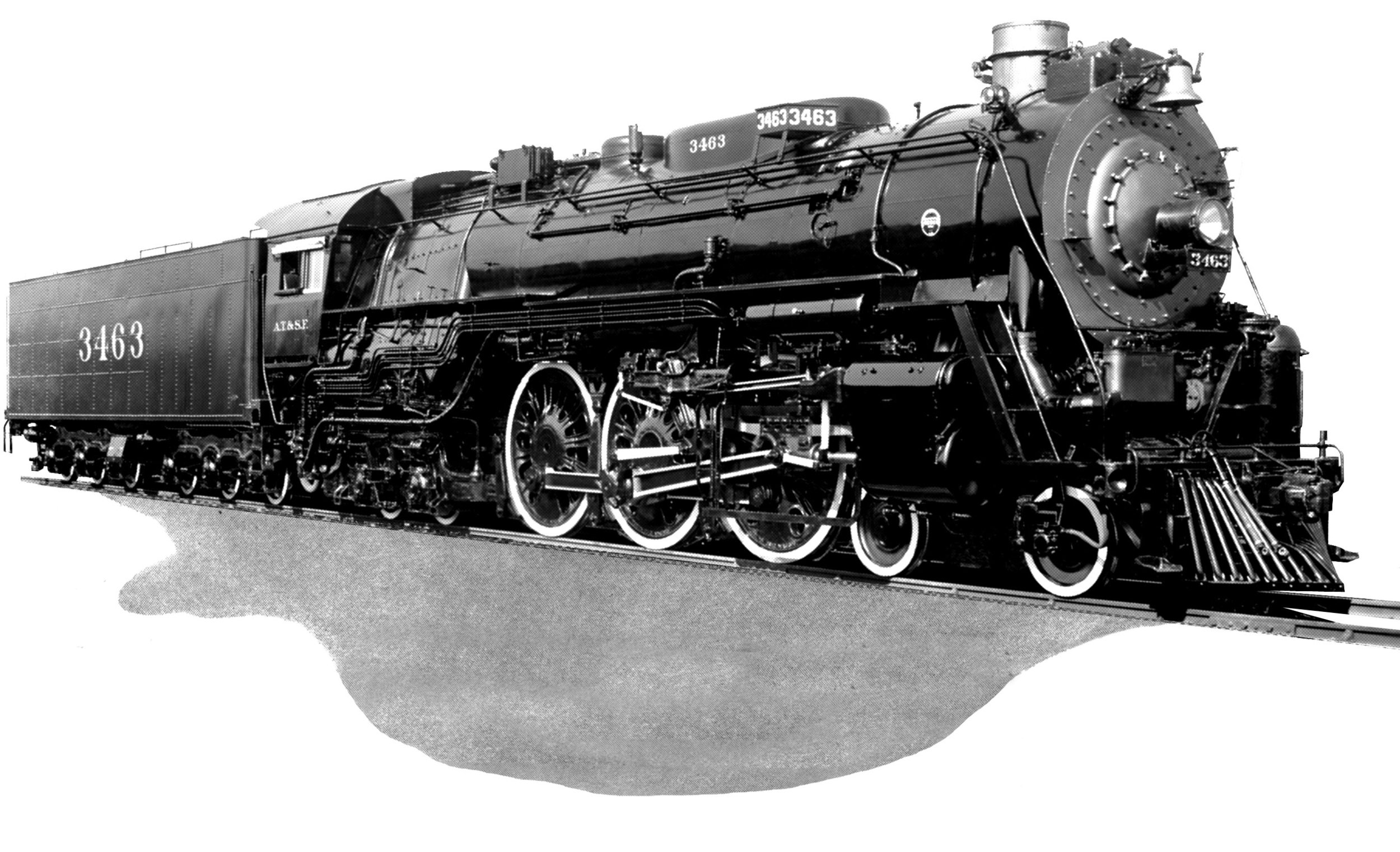
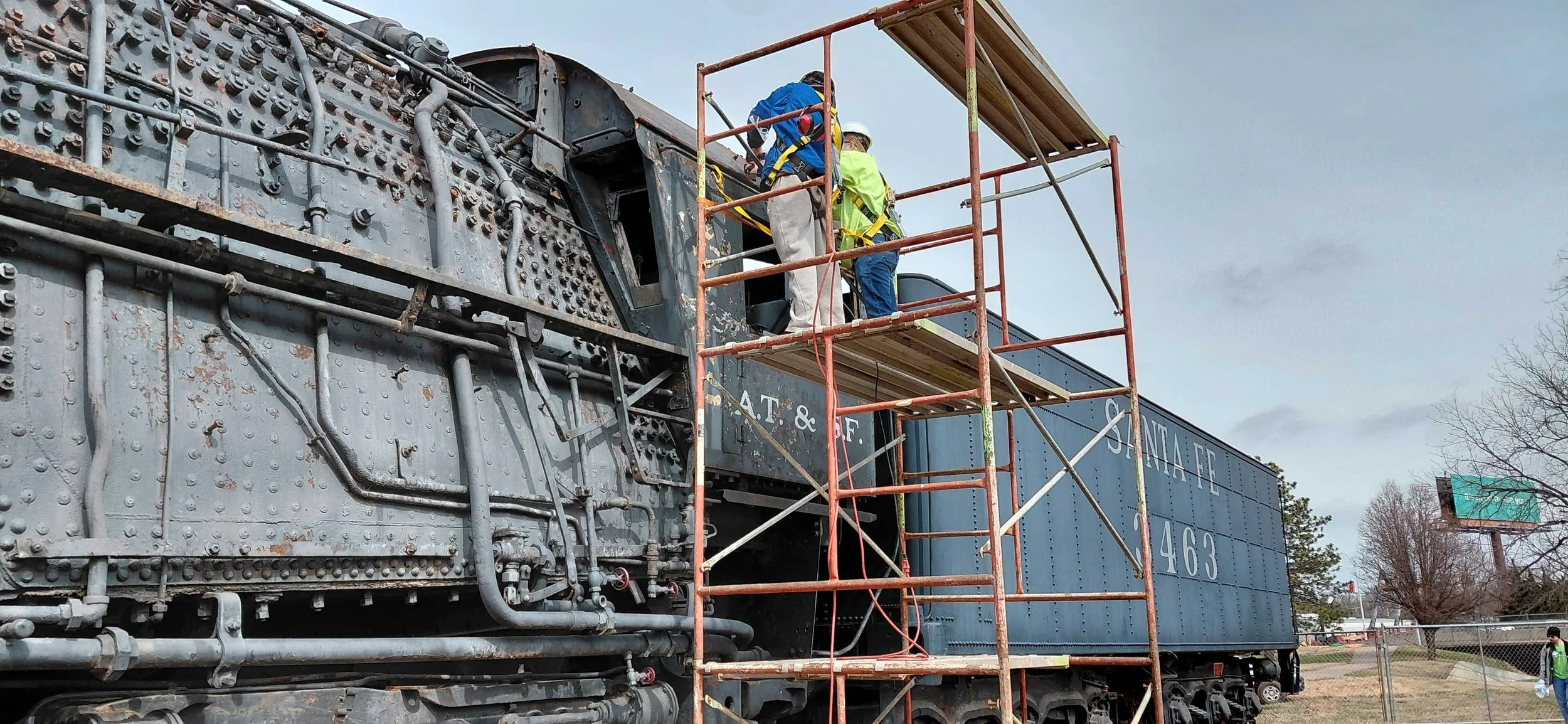
T O P E K A,  K A N S A S | April 11, 2017 –  Shawnee County District Court has ruled in favor of Sustainable Rail International d/b/a Coalition for Sustainable Rail (CSR) in its case concerning quiet title of the former Atchison, Topeka & Santa Fe Railway (ATSF) steam locomotive No. 3463. District Court Judge, the Honorable Larry D. Hendricks, released a detailed decision concerning the case Wednesday, March 29, 2017, in which he finds that defendant Topeka Children and Santa Fe Railroad, Inc. (TCSFR) has no standing to remain in the lawsuit.  This decision paves the way for CSR to enter negotiations with the City of Topeka concerning the locomotive.

“Now that the court has determined that TCSFR does not have sufficient standing to remain in the lawsuit, we look forward to working with the City of Topeka to resolve the matter,” said CSR President Davidson Ward. “Of specific importance to CSR is outlining a realistic path forward that provides for the preservation of No. 3463 and a secure facility in Topeka for it to call home.”

CSR’s ownership of No. 3463 was first challenged by the TCSFR in April 2013 who, at that time, claimed absolute ownership of the locomotive. Following months of unsuccessful attempts to meet with TCSFR about its claims, CSR filed suit in May 2014 requesting a legal determination as to ownership of No. 3463. Shortly after filing suit, TCSFR reversed its position of outright ownership, claiming instead that they were trustees of a trust to protect the locomotive, and that the City of Topeka was the rightful owner, thus drawing the City into the suit as a Party Defendant.

“Through his decision, Judge Hendricks plainly sets forth why each of TCSFR’s arguments fails as a matter of law. While we were confident in our position, the decision clearly supports CSR and the filing of this litigation,” said outside counsel to CSR Matthew Bergmann, of Topeka-based Frieden, Unrein and Forbes, LLP.  “We are extremely pleased with Judge Hendricks ruling.”

Of specific importance to CSR is outlining a realistic path forward that provides for the preservation of No. 3463 and a secure facility in Topeka for it to call home.
— Davidson Ward | CSR

Though the project with No. 3463 has been on hold since 2013, CSR has worked diligently to refine its focus in both the preservation field and the steam and biofuel arenas in response to changing market conditions. Not only has the organization been retained to assist railroads in Germany and the U.S. with matters concerning steam locomotive preservation, but it has also been working with research collaborators at the University of Minnesota to further advance fuel and boiler technologies.