Accounts of U.S. Travelers in Argentina

CSR will be releasing its next White Paper, The Development of Modern Steam 3: The "Rio Turbio Railway" and GPCS, to the public in the coming few weeks. In anticipation of that release, CSR is making available a section of the White Paper - an account of a trip by two U.S. railroad aficianados to Rio Turbio in March 1991.  The following is a brief essay and corresponding photographs provided to CSR by supporters Jim Hebson and Ben Anderson (shown on board the RFIRT below center). Their story depicts an adventure from a different time and place. Enjoy.

Personal Reflections on the Ferrocarril Industrial Rio Turbio

Ben Anderson and Jim Hebson

Upon arriving in Buenos Aires from the United States in March 1991 for an extended exploration of Ferrocarriles Argentinos, we learned that the Argentinian railroad workers had gone on strike, shutting down the entire system with little prospect of an early resolution. Stunned by this setback at the very beginning of our trip, we began to consider alternative railway subjects to explore.

During these deliberations, we recalled hearing about an obscure coal-hauling railroad known as the Ferrocarril Industrial Rio Turbio (the “FIRT”), which ran between the Argentinian port of Rio Gallegos (the capital of Santa Cruz, the southernmost province of Argentina) and the coal mines at Rio Turbio, near the border with Chile. Both the railroad and the mines were operated by Yacimientos Carboniferos Fiscales (“YCF”), the Argentine state coal company.

The special purpose, point-to-point railroad was totally isolated, far from the southernmost extreme of the integrated Argentinian system. We further recalled that the FIRT was a 2-1/2 foot (750 mm) gauge, 100% steam powered railroad featuring large 2-10-2 Santa Fe-type locomotives, certainly an exotic railroad in an exotic location.

The two of us speculated that because the FIRT, located in the southernmost part of Patagonia, was isolated from the Argentinian railroad system, its operation might not have been affected by the strike, but we needed to confirm that fact. We obtained the address of the YCF headquarters in Buenos Aires and set out to obtain whatever information we could.

Contrast of old and new. At the coal terminal of Rio Gallegos, YCF operated a relatively-modern coal transfer system to create stockpiles of coal from which ships would be loaded. This equipment is still in operation today.


Contrast of old and new. At the coal terminal of Rio Gallegos, YCF operated a relatively-modern coal transfer system to create stockpiles of coal from which ships would be loaded. This equipment is still in operation today.

In those pre-security conscious days, we entered the building and wandered the empty corridors trying to decide which office to try, but before we could do so, an employee came down the hall, and we put our question to him. We were informed that the FIRT was indeed operating, and the employee graciously offered to introduce us to the railroad management. That chance encounter resulted in an afternoon of extraordinary hospitality as we met with executives at increasing levels of authority, including an elderly Swedish engineer who had worked on the construction of the FIRT as a young man in 1949. We were enthusiastically encouraged by all we met to undertake the long journey from Buenos Aires to Rio Gallegos to see the FIRT in action. 

We left the YCF building that afternoon with the all-important, door-opening “Letter of Introduction” (to the railroad’s general manager) in hand and made arrangements to fly to Rio Gallegos as soon as possible.

Rotary dump narrow gauge. Like many modern coal-hauling railroads, the RFIRT employed coal gondolas that were dumped using the rotary dumper shown above - each railcar is emptied by being flipped upside down.


Rotary dump narrow gauge. Like many modern coal-hauling railroads, the RFIRT employed coal gondolas that were dumped using the rotary dumper shown above - each railcar is emptied by being flipped upside down.

In Rio Gallegos, the warm hospitality of FIRT began with in-depth inspection tours of the engine terminal, shops and coal handling equipment. We then met with officials to discuss the engineering and operational aspects of this highly unusual railroad. At the conclusion of the meeting, our host apologized that the FIRT did not carry passengers. (Because the railroad was dedicated solely to hauling coal, we had not expected that it did.) We were therefore delighted when our host announced that, if we would like, the railroad would be pleased to accommodate our interest in the FIRT by putting a special business car on the next westbound (empty) train so that we could examine the entire 153-mile main line and the coal facilities at Rio Turbio itself.

Narrowest passenger car ever? This photo by Anderson shows one of the few passenger railcars maintain by the RFIRT. In the background, locomotive 101 is performing switch movements prior to assembling the train they took from Rio Gallegos to the min…


Narrowest passenger car ever? This photo by Anderson shows one of the few passenger railcars maintain by the RFIRT. In the background, locomotive 101 is performing switch movements prior to assembling the train they took from Rio Gallegos to the mine at Rio Turbio.

When we presented ourselves at the yard on the morning of the day of departure, the railroad was a beehive of activity. We watched in anticipation as one of the 2-10-2 locomotives pulled a diminutive wooden coach – the “special business car” - from a shed.

Our host explained that he assumed we would like “our” coach placed directly behind the locomotive, better to observe the operation of a hard working 2-10-2 steam engine. In addition to our special car, the train consisted of a guard’s van, a long string of empty coal hoppers, and an out-of-service, deadheading 2-10-2 (at the end of the train) with its rods removed for the trip.
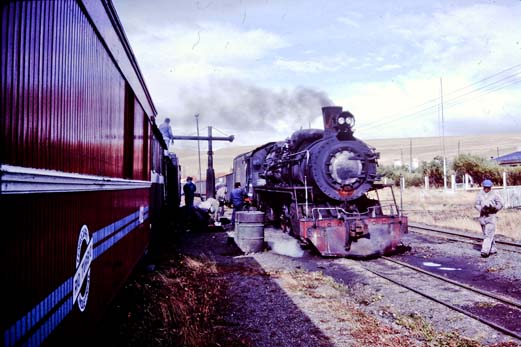
he meet at Estacion Capa provided a taste of the train the authors would ride in return the following day.


he meet at Estacion Capa provided a taste of the train the authors would ride in return the following day.

Our wood paneled coach was comfortably equipped with a lounge area, a table, a pot belly stove, bunks, and a galley. We were accompanied on our journey by the Chief Mechanical Officer.

The outbound trip took twelve hours, as the vast Patagonian landscape unfolded with sweeping curves, gentle grades and distant hills, with occasional stops for water at desolate windmill-driven pumps, engine servicing, and a meet with an inbound train at Estacion Capa.

Upon arrival at Rio Turbio at 9 P.M., our host accompanied us to a local restaurant for dinner and then welcomed us to stay at the FIRT bunkhouse for the night. After breakfast at the bunkhouse in the morning, we departed Rio Turbio. Once again a single 2-10-2 was sufficient for the task.

Late that night the bright lights of Rio Gallegos illuminated the clear Patagonian sky, signaling our final approach and the end of our trip on the “southernmost railroad in the world.”

This shot taken from the first car behind the locomotive shows the 50+ car train snaking through the beautiful, albeit barren, valley landscape that the FIRT called home.

This shot taken from the first car behind the locomotive shows the 50+ car train snaking through the beautiful, albeit barren, valley landscape that the FIRT called home.

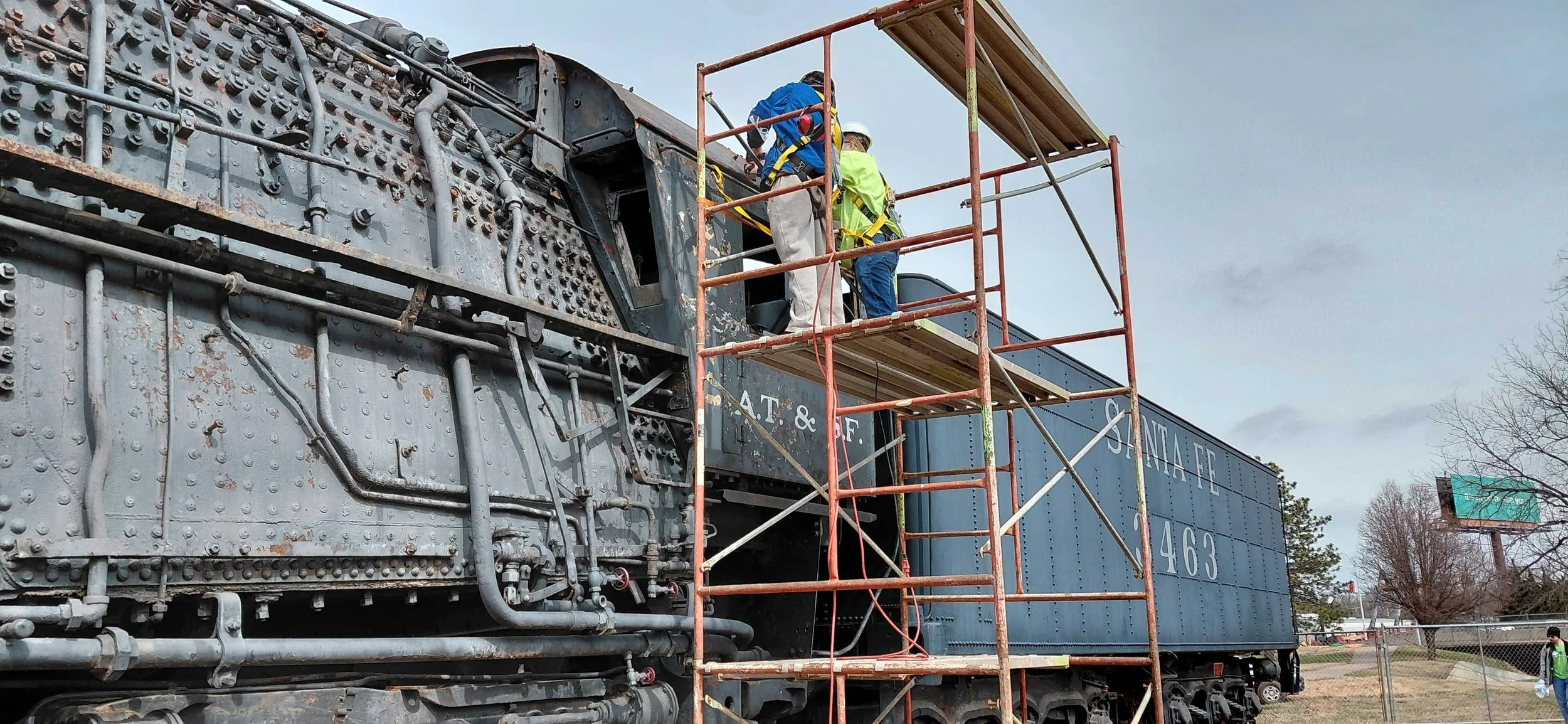
A 1938 Perspective on the 3460 Class

On this "throwback Thursday," enjoy a detailed article from the March 12, 1938 pages of Railway Age.  From the archives of a CSR Board Member comes this detailed look at the 3460-class of locomotives, of which 3463 is a member.  At the time, railroads tended to work with locomotive manufacturers to design locomotives to suit their needs, a uniqueness that was both beneficial in providing route-specific designs but detrimental in that it lead to a lack of standardization across companies and parts manufacuturers.

It is interesting to note the level of detail provided by the article, from detailing the camber of the driving axle springs to the specific type of staybolts employed.  It is worth highlighting that the designers were conscious of the potential need to change fuel types:

"The oil tank is integral with the water-tank structure. Conversion for coal can be made by removing the top of the oil tank over the coal space and substituting coal gates for the front oil-tank closure."

Read the entire article here or by clicking on the image above.

New CSR Board Member: Dr. John Betak

The CSR team is pleased to announce John F. Betak, Ph.D. as the newest member of its Board of Directors.  Rounding out the qualifications of the other CSR board members, Dr. Betak brings an unparalleled level of experience in the field of transportation and technology research. 

Dr. Betak is a senior consultant with 40+ years of diversified, international experience in management, consulting, administration and research in corporations, non-profits and major North American universities.  John was an AVP at Consolidated Rail Corporation (Conrail) where he developed/managed the corporate industrial development, plant rationalization and line sales, short line marketing, non-hazardous solid waste business group, real estate portfolio and Geographic Information System prior to his retirement in 1995.

John was part of the team that developed the plan that led to the restructuring of Conrail and its return to profitability. Key elements of that plan led to the passage of NERSA and a fundamental shift in the rail industry's ability to restructure their operations. It also led to the development of the modern short line and regional railroad industry.

In addition to extensive industry leadership, Dr. Betak has been involved heavily in railroad and industry risk resaerch at the University of Texas at Austin and at the Center for Advanced Infrastructure and Transportation at Rutgers University. His insight into issues relating to all facets of the railroad and energy industries will be of specific importance as research in these fields continue to develop.

Porta's First Locomotive - "Argentina"

CSR released today its newest White Paper in its series on the Development of Modern Steam: "Argentina - Porta's First Locomotive."

Porta had corresponded extensively with Andre Chapelon, the focus of CSR's last white paper, following his education as a Civil Engineer. At age 25, Porta was able to convince financiers to back the concept of modifying an antiquated 4-6-2 into a modern 4-8-0. Over the next three years (from 1947-1950), Porta completely rebuilt and modernized the locomotive, the results of which laid the foundation for developments he championed in the half-century to follow.

The story of Argentina shows the incredible drive of a young, very industrious engineer in successfully conceiving, coordinating, financing, designing, building and testing a very modern steam locomotive. Virtually every known thermodynamic improvement available at the time was applied in its construction. The locomotive set world records for thermal efficiency and power-to-weight ratio for steam locomotives.

CSR Expands International Collaboration, Welcomes New Technical Advisors

CSR is pleased to announce the addition of two new Technical Advisors to its team: Iiro Hirvensalo, M.Sc. and W. Hugh Odom, P.E. 

Hirvensalo, [SHOWN ABOVE], is an accomplished Finnish mechanical engineer and steam locomotive expert. His career has spanned all manner of heavy manufacturing, design, project management and consulting on behalf of a variety of Finnish companies.  Not only involved in mechanical engineering, his accomplishments include being a degreed Clarinetist from the Sibelius Academy and is active in the operation/maintenance of mainline steam locomotives.

Hirvensalo's current work, post-retirement, focuses on the completion of a Ph.D. in Mechanical Engineering with a focus on modern steam locomotives from the Helsinki University of Technology.  CSR is excited to welcome Hirvensalo who is helping to  expand CSR's knowledge base and assisting on technical matters concerning boiler systems in Europe.  

He has maintained a life long passion for railroads, serving as a founding member of the Railway Historical Society of Finland in 1967, an organization with more than 1,000 members today. Hirvensalo is also heavily involved in the operation of Finnish mainline steam locomotives, including 4-6-2 type number 1009 [SHOWN ABOVE].

Hugh Odom, P.E. [SHOWN AT RIGHT] is no stranger to the world of modern steam locomotives.  A 1978 graduate of Clemson University with a BS in mechanical engineering and a registered Professional Engineer in South Carolina, he has worked as a project manager, mechanical engineer, environmental engineer, and nuclear engineer at various times in his career, and has over 30 years of professional experience. In addition to working for the Navy and the US Army Corps of Engineers, Odom spent 2 years with Norfolk Southern as a gang foreman in the motive power department. Odom was also briefly involved with excursions with NKP 765 and N&W 611 during this time.

In the 1980's, Hugh was an active member of the Charleston Chapter of the National Railway Historical Society and was a charter member of the South Carolina Railway Museum.

Since the late 1990's, Hugh has maintained a website dedicated to advanced steam locomotives called "the Ultimate Steam Page". Through this page, Hugh established contact with other advanced steam enthusiasts and professionals around the world. Hugh has assisted with projects such as the 5AT Advanced Steam Locomotive Project and the Cliffside 110 restoration project. CSR is excited to welcome Hugh's involvement in its research undertakings, including his assistance on recent White Papers.

Announcing Development of Modern Steam White Paper Series

CSR has invested significant time and effort into creation of its "White Paper Program" with the intent of providing substantial bodies of information about the history, principles and viability of modern steam technology, advanced biofuel research and the union thereof to the general public. As 2014 begins, CSR is venturing into completion of its most in-depth white paper series yet - a detailed history of the "Development of Modern Steam." This series will focus on the history and technological developments undertaken in Europe, South America, Africa and North America.

This first paper, "André Chapelon and his Steam Locomotives" focuses on the predecessor mechanical engineers of modern steam locomotives, primarily the French locomotive designer André Chapelon. The application of fluid and thermodynamics to the steam locomotive was most successfully undertaken by Chapelon on the Paris Orleans Railway and, once nationalized, the Société Nationale des Chemins de fer Français (SNCF). His understanding of the "steam circuit," the utilization of advanced front end exhausts paired with large steam passages and his successful utilization of "compounding," that is using steam more than once, were as successful in theory as they were in practice.